

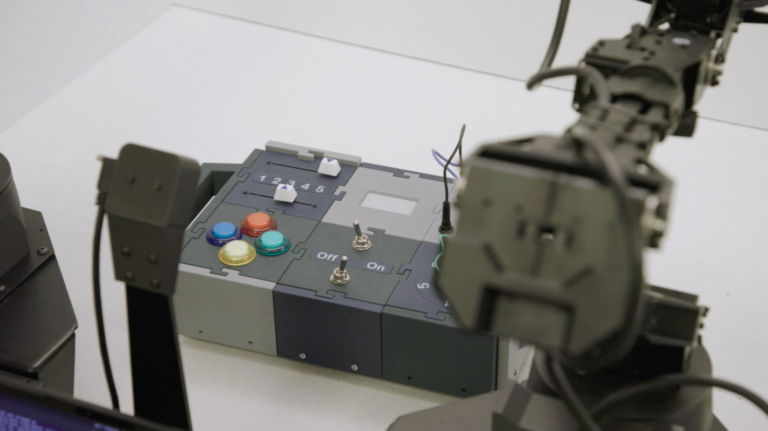
Microsoft has announced Rho-alpha (ρα), its first robotics model derived from Microsoft’s Phi series of vision-language models.
Rho-alpha translates natural language commands into control signals for robotic systems performing bimanual manipulation tasks.
It can be described as a VLA+ model in that it expands the set of perceptual and learning modalities beyond those typically used by VLAs.
For perception, Rho-alpha adds tactile sensing, with efforts underway to accommodate modalities such as force.
For learning, Microsoft is working toward enabling Rho-alpha to continually improve during deployment by learning from feedback provided by people.
Additionally, the training pipeline generates synthetic data via a multistage process based on reinforcement learning using the open NVIDIA Isaac Sim framework.
Through these advancements, the company aims to make physical systems more easily adaptable, viewing adaptability as a hallmark of intelligence.
Microsoft is also working towards building robots that can adapt more easily to dynamic situations and to human preferences will be more useful in the dynamic environments.
The company has now officially invited those organisations interested in evaluating Rho-alpha for their robots and use cases to express interest in the Rho-alpha Research Early Access Program.
Rho-alpha will also be made available via Microsoft Foundry at a later date.
Microsoft Research Accelerator corporate vice president and managing director, Ashley Llorens, said: “The emergence of vision-language-action (VLA) models for physical systems is enabling systems to perceive, reason, and act with increasing autonomy alongside humans in environments that are far less structured.”
IntraLogisteX is heading to Dallas, Texas in 2026, bringing the industry’s specialist trade show and conference to one of North America’s key logistics hubs. Join supply chain, manufacturing, robotics and automation leaders on 16–17 September 2026 at the Kay Bailey Hutchison Convention Center and explore hands-on demos, new launches and practical ideas to boost efficiency and scalability.