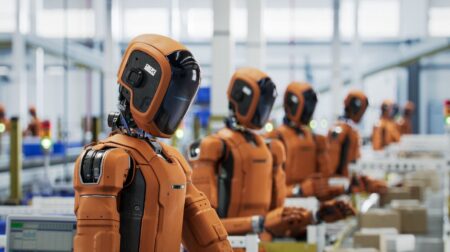

Humanoid, a UK-based robotics and AI company, has unveiled HMND 01 Alpha Bipedal, a bipedal robot which was capable of stable walking only 48 hours after final assembly.
The team relied on 3D modelling to create prototypes that closely match simulation, minimising the “sim-to-real” gap that often slows humanoid development.
Using Nvidia’s Isaac Sim and Isaac Lab, the team trained more than 52.5 million seconds of reinforcement-learning locomotion data in simulation, equivalent to nearly 19 months of conventional training, in only two days.
The robot took its first real-world steps after just 3.2 million seconds, with minimal randomisation needed to handle external pushes of up to 350 Newtons.
Standing 179 centimeters (5’10’’) tall with 29 degrees of freedom excluding end-effectors, Alpha combines top-class upper-body strength with a bimanual payload capacity of 15kg (33 lbs).
Its modular end-effectors can be fitted with either 12-degree-of-freedom five-fingered hands or 1-degree-of-freedom parallel grippers, while its head features six RGB cameras, two depth sensors, and a six-microphone array.
The robot’s body is equipped with haptic sensors, force/torque sensors, and joint torque feedback, all powered by Nvidia Jetson Orin AGX and Intel i9 processors.
Its battery provides three hours of swappable power, ensuring extended operation during testing and development.
Alpha Bipedal is designed for robust and repeatable performance across multiple applications, including industrial, household, and service tasks.
It can walk in straight and curved trajectories, turn in place, sidestep, squat, hop, run, manipulate objects with precision, recover from omnidirectional pushes, and coordinate with other humanoid or wheeled robots.
Beyond locomotion and manipulation, it can engage with humans via a head display, LEDs, speakers, and audio sensing, while its VLM and VLA-based KinetIQ framework enables advanced reasoning and task execution.
The platform is optimised for low total cost of ownership, fast training and adoption of AI policies, and high payload-to-cost ratio.
Founder and CEO of Humanoid, Artem Sokolov, said: “HMND 01 is designed to address real-world challenges across industrial and home environments.
“With manufacturing sectors facing labour shortages of up to 27%, leaving significant gaps in production, and millions of people performing physically demanding or repetitive tasks, robots can provide meaningful support.
“In domestic environments, they have the potential to assist elderly people or those with physical limitations, helping with object handling, coordination, and daily activities.
“Every day, over 16 billion hours are spent on unpaid domestic and care work worldwide — work that, if valued economically, would exceed 40% of GDP in some countries.
“By taking on these responsibilities, humanoid robots can free humans to focus on higher-value and safer work, improving their productivity and quality of life.”
Join 400 exhibitors and 10,000 industry leaders at Robotics and Automation Exhibition on 18-19 March 2026 at NEC Birmingham to explore cutting-edge technologies, connect with peers and discover the latest innovations shaping the future of manufacturing, engineering and logistics. Register for free now to secure your place at this unmissable event!