Sellafield Ltd. and the Robotics & AI Collaboration (RAICo) have announced a successful trial of a contamination swabbing tool, mounted on a quadruped robot, in an area containing radioactive material.
Swabbing uses circular paper filters to monitor radiation levels across a range of surfaces, providing vital data that informs decommissioning strategies and ensures compliance with safety regulations.
Sellafield stated that its Health Physics Team carries out hundreds of swabs each day in contaminated areas.
This specific swabbing tool was developed through RAICo to accelerate the deployment of robotics and AI for nuclear decommissioning and fusion engineering.
RAICo is a collaboration between the UK Atomic Energy Authority, the Nuclear Decommissioning Authority (NDA), Sellafield Ltd and the wider NDA nuclear estate, the University of Manchester, and AWE Nuclear Security Technologies
The partnership stated that the new design can replicate the complex and dextrous non-linear swabbing motion normally carried out by humans.
This is possible due to the unique shape of the attachment, alongside an off-the-shelf haptic controller from Haply Robotics, and custom RAICo-developed software, which captures an operator’s real time hand movements and translates them into commands for Spot’s manipulator.
The deployment was conceived and planned by Sellafield’s Remote Technology Group, which is responsible for evaluating and deploying robotics, AI, and unmanned systems at the site.
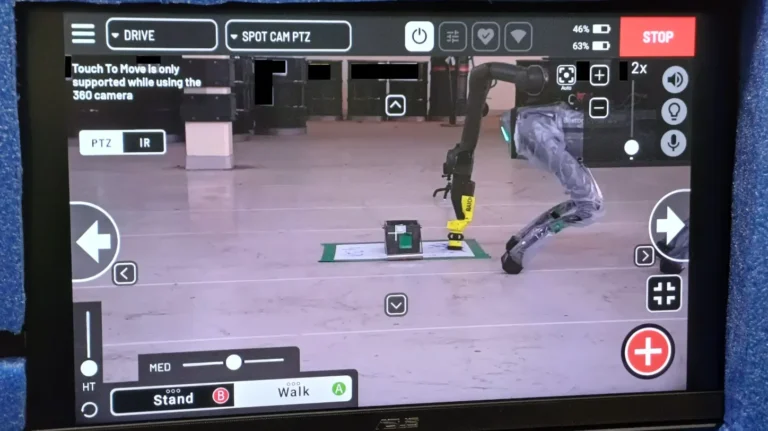
During the controlled deployment, Spot (the quadruped robot) was sent into a restricted area to inspect a simulated radiological spill and take a physical swab from a mock-contaminated surface.
The robot used the new tool to swab the surface and bring back a sample of blue chalk, used to simulate the contamination.
The robot completed the task successfully, showing that a process traditionally performed by humans could potentially be carried out remotely without compromising accuracy or safety.
The successful trial points to the potential for wider use of robotics across Sellafield and the nuclear estate, helping to reduce risk, improve efficiency, and maintain high safety standards in nuclear decommissioning operations.
RAICo director, Dr. Kirsty Hewitson, said: “This deployment is a perfect example of how collaboration between RAICo partners generates significant benefits for end users in the nuclear sector.
“In this case, innovation developed collaboratively by RAICo members, academic institutions, and companies in the UK supply chain, was trialled at another member’s site to support a specific task that their frontline operators have to deliver every day.
“By working as a single, integrated team, we are all avoiding duplication and together we are delivering greater value from the public investment of taxpayer money.
“Furthermore, the deployment at Sellafield follows a similar successful inactive test at the Joint European Torus (JET) facility in Culham earlier in 2025, suggesting that this new technology could have an impact on both nuclear decommissioning and fusion engineering sites.”
 Join more than 11,000+ industry professionals at Robotics & Automation Exhibition on 18–19 March 2026 at the NEC Birmingham to explore cutting-edge technologies, connect with peers and discover the latest innovations shaping manufacturing, engineering and logistics. Register for free to secure your place.