

If 2024 was the year robotics and automation proved it could scale, 2025 was the year the conversation moved on to how it scales: skills, integration, capital, regulation and measurable outcomes. Across the year, Robotics & Automation Magazine’s most-read stories told a consistent story about where industry attention is really landing – workforce strategy, real-world deployment and the national policies that will either accelerate adoption or hold it back.
What follows is a snapshot of 2025 through the lens of Robotics & Automation Magazine’s audience: the biggest stories on the site, the Akabo Media events that brought the ecosystem together, the headlines that shaped deployment, and the long-form print, video and comment content that generated the most engagement.

These were the five biggest Robotics & Automation Magazine stories of the year by page views — and they share a theme: scale is no longer theoretical.
1) Amazon plans 600,000-strong US robot workforce by 2033
Amazon’s long-range ambition crystallised a wider truth: robotics is moving from “automation projects” to a workforce strategy, with scale targets that force questions about systems integration, maintenance, safety and skills.
2) Humanoid Robotics Data Training Center opens in Beijing
A 3,000m² training facility with 10 real-world environments and large-scale data generation underlined how the humanoid race is increasingly a data and validation race, not just a hardware one.
3) NAES and Gecko team up to modernise US power plants amid energy crisis
Readers were drawn to what ‘robotics + AI’ looks like in critical infrastructure: multi-year agreements, inspection and reliability use cases, and automation positioned as operational resilience.
4) Glīd closes oversubscribed US$3.1m pre-seed round to launch autonomous road-to-rail freight solution
An early-stage funding story that still hit a nerve: autonomous systems aimed at specific bottlenecks (first-mile port-to-rail movement) and designed around infrastructure constraints.
5) ABB sells robotics unit to SoftBank for US$5.375bn
Few headlines captured 2025’s ‘industry reshape’ mood as clearly as this: consolidation, capital moving decisively, and robotics treated as a strategic platform rather than a side division.

Robotics & Automation Magazine continued to provide coverage across its publisher Akabo Media’s events portfolio – reflecting a year in which the industry increasingly wanted live benchmarking, deployment-led case studies and practical conversations about ROI.
Robotics and Automation 2025: the UK’s biggest automation showcase got bigger
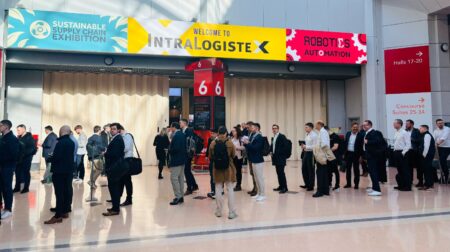
Robotics and Automation 2025 drew thousands to the NEC Birmingham on 25–26 March, with more than 200 exhibitors and more than 60 conference sessions spanning topics from human–robot collaboration to Robotics-as-a-Service. The event’s co-location alongside IntraLogisteX and the Sustainable Supply Chain Exhibition reinforced a joined-up message: robotics is now inseparable from the wider operational stack across manufacturing, warehousing and supply chain performance
IntraLogisteX USA 2025: “deployable now” automation, with AI as the control layer
In the USA, IntraLogisteX returned to Miami Beach Convention Center in September with an emphasis on deployable automation – particularly AI-enabled orchestration and flexible mobile robotics. The show positioned control layers and integration as differentiators, reflecting a market that is increasingly allergic to rip-and-replace transformation programmes.
Fulfilment & Last Mile Expo to launch in 2026
In September, Akabo Media announced Fulfilment & Last Mile Exp, launching at the NEC on 18-19 March 2026 alongside Robotics & Automation Exhibition, IntraLogisteX and the Sustainable Supply Chain Exhibition. The move formalised a trend that shaped 2025: attention shifting beyond the warehouse into post-warehouse execution, last-mile innovation and end-to-end service performance.
Robotics & Automation Awards to go live in 2026
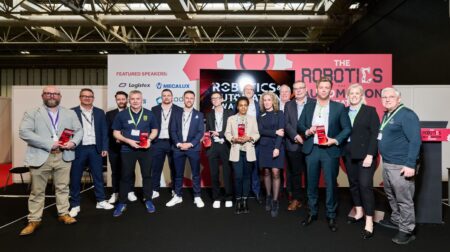
In November, Robotics & Automation Magazine confirmed a major refresh of the Robotics & Automation Awards: from 2026, the awards will take place live on Day One of Robotics & Automation Exhibition at the NEC, with exhibitor-only eligibility across the co-located shows. The direction of travel is explicit – recognition anchored in real deployments, measurable benefits and supplier outcomes that stand up to scrutiny on the show floor.

A digest of the most important developments to affect the deployment of robotics and automated technologies during the past 12 months:
Budget 2025: compute, capital and skills move from rhetoric to programme design
2025 reinforced that automation policy is increasingly framed around enabling conditions: compute infrastructure, investment levers and workforce readiness.
Robot installations: the “normalisation” of automation at global scale
The direction of travel is clear: the installed base continues to rise, and the industry’s attention is shifting from novelty to lifecycle — uptime, service, software and systems engineering.
UK Trade Strategy: resilience and reshoring become explicit industrial objectives
Where automation is deployed is becoming as strategic as whether it is deployed, as firms reassess resilience, compliance and supply risk.
UK Industrial Strategy: robotics woven into the growth model, not treated as a niche
The strongest signal from 2025 was that robotics and automation is increasingly treated as a foundational capability across sectors, not a niche “advanced manufacturing” topic.
Smart Machines 2035: a 10-year plan to make robotics a national capability
The long-term plan framing matters: it signals seriousness, but it also raises expectations – particularly around delivery, funding, standards and the practical mechanisms that turn strategy into deployments.

In 2025, the pattern is unmistakable: viewers rewarded novelty and real-world deployment.
1) Scientists develop cannibalistic robots
A classic “what did I just watch?” robotics moment – high concept, highly shareable, and proof that the audience still loves breakthrough experimentation.
2) Cartken launches autonomous hauler robot
A practical autonomy story that sits at the intersection of labour pressure and predictable, repeatable movement tasks.
3) Robotic hippotherapy brings horse-free rehabilitation to patients
Healthcare robotics continues to draw attention when it pairs novelty with a clear human outcome.
4) UK MoD trials robotic systems for bomb disposal
A reminder that some of the most mature, mission-critical robotics deployments sit in defence and security.
5) South Korea leads global robotics adoption as investment rises
A macro video that reflects a year in which national competitiveness, not just product innovation, drove the robotics conversation.

The Comment section is where externally contributed thought leadership and academic analysis stepped back from announcements and focused on consequences: productivity, jobs, trust and the limits of technology narratives. This year’s best performers weren’t just about robots — they were about the world robots are landing in.
Four reasons why the UK lags behind its rivals on productivity
The runaway leader — and tellingly, it’s about the underlying constraint that sits beneath most automation debates. Readers clearly wanted an explanation of why productivity is stuck, not just what technologies might fix it.
Amazon’s new robot has a sense of touch, but it’s not here to replace humans
A high-performing piece because it addressed the anxiety directly: what “new capability” actually means for work, and why the framing matters.
The search for missing plane MH370 is back on. An underwater robotics expert explains what’s involved
A specialist explanation that travelled well beyond the core audience – using a global news hook to showcase the practical realities of underwater robotics.
Seven advances in technology that we’re likely to see in 2025
Predictive, accessible and broad – the kind of piece that attracts new readers, even if specialists treat it as a starting point rather than the final word.
Is AI really coming for our jobs and wages? Past predictions of a ‘robot apocalypse’ offer some clues
A measured counterweight to hype, and another signal that readers value context: what’s changed, what hasn’t, and which claims deserve scepticism.

If the website’s biggest stories in 2025 were about scale, investment and bold corporate moves, the magazine’s print editions were where readers went for the mechanics: how programmes are designed, how people adapt, what “good integration” looks like and where the hidden risks sit.
Most popular issue: August 2025 (15,000 views)
August landed because it tackled the hardest part of modern automation: the human operating model. Its standout line-up leaned into workforce transformation and wellbeing, collaborative robots, human-robot interaction and AI-powered skills assessment – a mix that mirrors what readers engaged with most across web and comment content: capability-building, trust and deployment reality.
Standout features across 2025 issues
March 2025: a forward-facing “industry calendar” issue anchored around Exhibition momentum, plus machine vision, next-generation robotics and conveyors/sortation – the enabling building blocks that keep deployments working at scale.
May 2025: AI readiness vs ambition, Covid’s five-year legacy for automation, supply chain decarbonisation, resilience and a GXO site visit – a practical package built around what operational leaders actually need to decide and deliver.
November 2025: global robotics demand, health and safety, trade regulations and government policy – an issue that connected technology choices to the political and economic realities shaping investment decisions.
Subscribe for free to the quarterly print edition of Robotics & Automation Magazine for exclusive insights into the key business issues shaping the future of robotics, automation and industrial AI. Stay ahead of the curve by signing up for the free Wired In weekly newsletter, delivering the latest news, analysis and case studies direct to your inbox every Friday. For even more updates, follow Robotics & Automation Magazine on LinkedIn and X.